For a bakery or food brand, cinnamon is more than a familiar spice. It influences aroma, colour, flavour consistency, product positioning and customer expectations.
That is why choosing the right Ceylon cinnamon requires more than comparing prices per kilogram. You need to know which form suits your production line, which grade supports your flavour profile, and whether your supplier can provide consistent batches with the documentation your business requires.
This guide explains how to evaluate Ceylon cinnamon for bakeries, confectionery brands, beverage companies and food manufacturers: from premium quills to bulk Ceylon cinnamon powder and extracts.
A home baker may adjust a pinch of cinnamon by taste. A commercial manufacturer cannot make the same assumption across hundreds or thousands of batches.
Small variations in cinnamon can affect:
Ceylon cinnamon, botanically known as Cinnamomum verum, is valued for its delicate, naturally sweet and fragrant profile. It is different from the stronger, more pungent cinnamon types commonly sold as cassia.
For commercial buyers, the goal is not simply to find “cinnamon.” It is to source an ingredient with a clearly defined species, grade, form, specification and supply plan.
The best format depends on how your business uses cinnamon and how much control you want over processing.
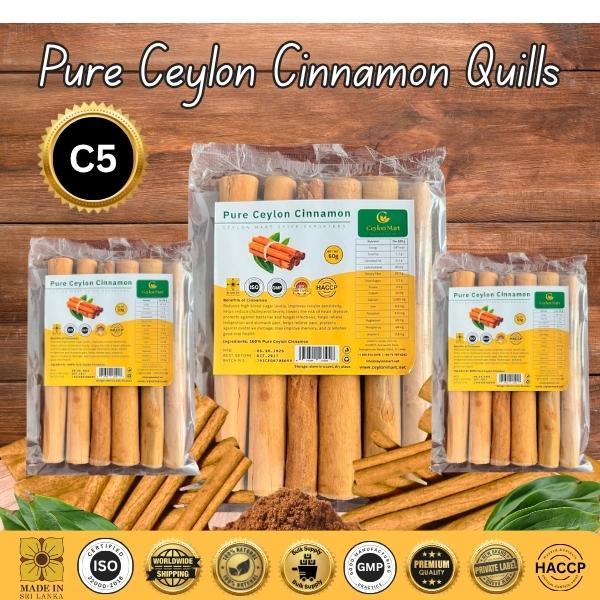
Quills are the carefully rolled inner bark of the cinnamon tree. They are the most recognisable form of Ceylon cinnamon and are often selected by premium food brands, tea blenders and manufacturers that prefer to mill or infuse the spice themselves.
Quills may suit you if you:
The main advantage is traceability at the physical-ingredient level. You can inspect the quills for colour, texture, cleanliness and uniformity before processing.
The trade-off is that quills require additional equipment, labour, storage and quality controls.
For many bakeries and food manufacturers, bulk Ceylon cinnamon powder is the most practical option.
It can be incorporated directly into:
When requesting powder, do not specify only “ground cinnamon.” Ask for the powder to be identified by botanical species and source grade: for example, Ceylon cinnamon powder milled from C5 Special or C5 quills.
You should also define the required:
A powder that is too coarse may disperse unevenly. A powder that is too fine may behave differently during mixing, dust more easily and require additional handling controls. Your supplier should be able to recommend a particle size based on your production process.
Extracts and oleoresins are concentrated ingredients used when manufacturers want predictable flavour delivery at a controlled dosage.
They may be suitable for:
An extract is not automatically a replacement for powder or quills. It has a different sensory effect, production method and specification. Ask for details such as carrier ingredients, concentration, solvent or extraction method, storage conditions and recommended use level.
Pro Tip: If your product is marketed around the visual presence of cinnamon, choose quills or powder. If your priority is repeatable flavour in a liquid or highly processed application, investigate an extract alongside conventional spice formats.
Ceylon cinnamon grades are associated with the appearance and diameter of the quills, as well as their overall quality and presentation.
C5 Special is a premium Ceylon quill grade commonly considered for high-quality commercial applications. It is generally associated with relatively fine, uniform quills, a warm golden colour and a refined aroma.
For bakeries and food manufacturers, C5 Special may be useful when you want:
C5 or C5 Special does not automatically mean that every batch will perform identically. Harvest, processing, storage and milling can influence the final ingredient. The grade should therefore be one part of your evaluation: not the entire evaluation.
If you are balancing cost and performance, ask your supplier to compare C5 Special, C5 and other suitable grades using samples from representative lots. A slightly different grade may meet your production needs while improving commercial efficiency.
One important reason manufacturers distinguish Ceylon cinnamon from cassia is coumarin.
Ceylon cinnamon is naturally recognised as having significantly lower coumarin levels than cassia varieties. However, a responsible commercial sourcing programme should not rely on a general statement alone.
When coumarin matters to your formulation, request:
This is especially important for brands supplying children’s products, wellness ranges, sensitive formulations or markets with strict customer and retailer requirements.
Important: Regulatory limits and acceptable use levels can vary by market and product category. Your technical or regulatory team should confirm the requirements that apply to your finished product.
A strong supplier conversation should cover more than the product name.
Request a sample and assess it in the way you intend to use it. A powder that smells impressive in the bag should also deliver a pleasant, balanced note after baking, heating or blending.
Evaluate:
Ask how the supplier manages consistency between shipments. Useful questions include:
For food manufacturing, request a lot-specific CoA that may include:
The exact testing panel should reflect your market, product category and internal quality system.
Cinnamon is aromatic and can absorb odours if stored or packed poorly. Commercial packaging should protect the ingredient from:
Depending on your operation, you may require food-grade lined bags, sealed pouches, cartons, drums or palletised bulk packaging. Confirm whether the packaging is suitable for your warehouse and whether each unit carries the lot and best-before information you need.
A supplier can offer the right cinnamon and still be unsuitable if the ordering process does not fit your production schedule.
Before approving a source, clarify:
If you are a growing bakery, begin with a sample and a manageable commercial order. Once the ingredient is approved, discuss a supply schedule rather than waiting until stock is nearly exhausted.
For larger businesses, consider holding an approved reference sample and documenting your sensory and technical acceptance criteria. This makes it easier to identify changes between shipments.

When requesting a quotation for Ceylon cinnamon, include as much detail as possible:
A precise RFQ helps suppliers quote accurately and lets your technical team compare offers on more than price.
Your ingredient choice should support the product you are building: whether that is a premium bakery range, a distinctive confectionery line, a new beverage concept or a retail spice product.
Sri Lanka Stores helps connect businesses with authentic Sri Lankan products and international fulfilment options. For a commercial enquiry, share your preferred format, grade, estimated volume, destination market and documentation requirements.
Pro Tip: Ask for a tailored quotation rather than selecting a generic listing. Your required mesh, packaging, MOQ and testing documentation can significantly influence the best sourcing option.
Submit a B2B enquiry through Sri Lanka Stores or contact the team at +94 76 837 3023 to discuss your requirements.
With the right specification and a dependable supply partner, the vibrant aroma of authentic Ceylon cinnamon can become a consistent part of every batch you produce. 🌿